Author: Christopher Woodward

  • Follower Inflation is a Real Thing Now

    Follower Inflation is a Real Thing Now

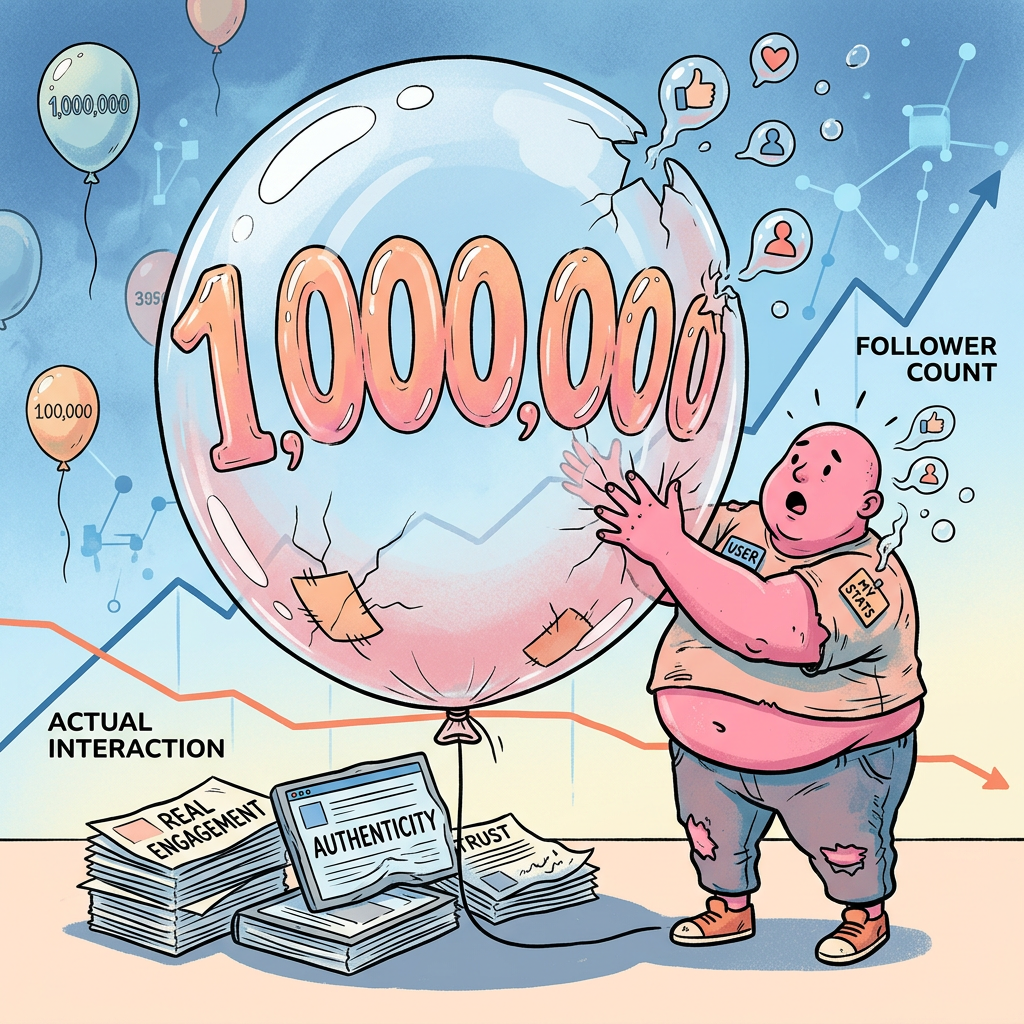
    We are currently living in a time where having a million followers on this platform is about the same as having a few hundred thousand on this one and a few thousand on this other one. This is “follower inflation”.

    Google has recently announced a new feature for creators to have a creator page in their search engine, and their requirements for how many followers you must have to be eligible actually vary based on what platform your following is on. These platforms have leveraged the fact that most humans will sacrifice everything in their lives for social status by making pseudo-fame an easy-to-achieve goal for them.

    Businesses now have to manage the risk of amateur reviewers and influencers who prioritize low-quality attention over substance trying to package and leverage inflated social status on platforms that sell this easy-fame like drugs to addicts.

    In the early 2010’s, there were people who genuinely believed they had 500 “friends” because of popular social media platforms. In the 2020’s, there are people who genuinely believe they have tens of thousands of “followers”. This is obviously a growing psychological factor that will present new risks to serious business-owners.

    This does come with opportunities for serious business-owners, however. The non-serious business owners who prop their businesses up with social status, coffee mixers, and low quality inner-circles will now see their businesses strained by this as having “followers” is losing its value the same way a dollar in USD has lost its value over the past several decades.

  • Short-term vacation rentals are a forward-priced market

    Short-term vacation rentals are a forward-priced market

    Typical real estate methodology for analyzing short-term vacation rentals produces inaccurate metrics. Unlike traditional long-term real estate, you cannot put a list of properties into a lot and calculate “occupancy” or “vacancy”. Each property is an independent entity. Short-term rentals, especially vacation rentals, are forward-priced while long-term real estate is priced based on backward-looking metrics. Short-term vacation rental hosts sell a perishable asset that left unsold will become an absolute total capital loss. This causes unpredictable speculative pricing.

    Short-term vacation rental rates are the result of purchasing and selling, not supply and demand. Nightly rates move based on pressures on both sides of the transaction where time-decay is a significant variable, creating volatile price movements which are also affected by inflation and seasonality, which further impact the value created.

    Short-term vacation rentals are a business asset where every stay has an expiration date, the value of the stays move with a single change in time, weather, inflation, or seasonality.

  • Navarre, Florida is in a housing bubble

    Navarre, Florida is in a housing bubble

    There are some boxes you must check to have a housing bubble.

    Easy Debt

    Low rates where anyone can get a mortgage are at the center of any housing bubble. Navarre, Florida didn’t just have low rates in 2020-2021; Navarre also has a lot of active duty military that have mortgage benefits, and are basically guaranteed a loan. Easy debt is part of the Navarre, Florida economy

    High Rents

    Rents are outrageously high in Navarre, and they are climbing.

    Prices Outweigh Wages

    It is impossible to live and work in Navarre. There is no way to get a job in Navarre and buy a home in Navarre.

    Price-to-Income Ratio is calculated by dividing the median sale price by the median household income.

    Speculation

    Housing bubbles see people coming in droves to buy a home for what it may be worth in the future. These homeowners are checking real estate platforms checking their property values regularly as if it were a liquid asset. The Navarre housing bubble is a direct result of speculation from posts on social media by amateur wannabe short-term rental investors.

    What saved people?

    If this is a housing bubble, why isn’t the market crashing? Why is their continued development? Why aren’t countless properties in foreclosure?

    There are foreclosures, but what saved people was fixed-rate mortgages. Many of these people locked in their low mortgage rate in the early 2020’s. The housing crisis of 2008-2009 was filled with predatory adjustable-rate mortgages where people were lured in in similar ways with low rates, just to have their mortgage rate raised later. That’s what lead to markets crashing. Everyone lost their homes at the same time.

    That same thing could (and likely would) have happened this time had it not been for fixed-rate debt. There is no doubt in a 6% mortgage rate market, lenders would have raised rates on all these people rather than collecting half or less of that.

    Why hasn’t the market crashed?

    The language of a housing bubble is deceiving. We are waiting for the “bubble to pop” or “burst”; we are waiting for the market to “crash”. All of this implies a sudden stop.

    In reality, housing bubbles are more like a giant object moving at a high rate of speed; they can’t just stop. They slowly grind to a halt. This is the situation in Navarre, Florida: the housing bubble is slowly grinding to a halt.

    How much longer will it last?

    This is difficult to say, but if looks anything like the 2008-2009 crisis, I would say we are going to continue to see these problems as well as property values declining for at least another one to two years.

  • The housing market in Navarre, Florida could be at risk with rising fuel costs

    The housing market in Navarre, Florida could be at risk with rising fuel costs

    Local transportation is the third highest household consumer expenditure for Navarre, Florida (U.S. Census Bureau, 2026). The mean commute time for people living in the Navarre, Florida area has historically stayed around 30 minutes (U.S. Census Bureau, 2024). If the mean commute time remains about the same as it has for many years while fuel costs continue to rise, the risk of household insolvency will substantially increase.

    Without localized job-growth in the Navarre area, inflated costs of transportation and high fuel costs will eventually make living in Navarre impossible for most people, which will lower property values correcting for housing inflation from 2021-2022. This correction is going to create a lot of bad debt from mortgages being more than the home is worth and people selling for a loss to move to an area that provides more opportunity.

    The more people move into Navarre, without jobs that pay a reasonable living wage or salary moving in with them, the more friction is added to Highway 98 as people must commute on Highway 98 to go somewhere they can work; the same is true of Highway 87. As bumper-to-bumper traffic sitting at a standstill becomes more and more a problem, fuel usage will increase substantially. If you pair this with rising gas prices, you get an unsustainable way of life for the majority of people. There is speculation that adding lanes to the highways is the solution, but I believe this is incentivized by a local county government dependent on residential development.

    Housing developments are historically easy to get approved when the developer builds the roads and sidewalks in the neighborhood and keeps it all private-owned within a home-owner’s association. This means the local government can collect property tax dollars without paying a dime to maintain the infrastructure. Inevitably, the underlying truth that the local government still must hook the properties up to city water and maintain the water lines, police the area, provide a school for the children, and maintain public roads these new residents will use daily catches up to them financially, and they are left with the simplest move to make which is approve more building permits and repeat the process. This nearsightedness is exactly what is creating the economic (and social) tension for the Navarre area. More and more people moving in without job growth creates fewer opportunities. This causes rising unemployment, which lowers wages and salaries, exacerbating the issue.

    This brings me back to my point that this increasing friction on the roadways from unsustainable residential growth, rising fuel costs, and diminishing opportunities will eventually trigger a trend in people selling their properties and moving closer to where they work. This is also going to cut into tourism development tax income for Santa Rosa County as people who were using platforms such as Airbnb and staying in hotels in Navarre to save money may decide it’s better to spend the money and stay in the areas where they want to spend their time avoiding having their vacation ruined by the traffic and frustrated other drivers. There are metrics local developers and small governments love to boast, but there is also on-the-ground truth, and the truth is Navarre is trending downward in appeal for residents, vacationers, and investors alike.

    The evidence of this playing out will start with symptoms of stretched budgets such as the roads decaying. Potholes go unrepaired, or fixed with patch work rather than roads being taken up and replaced with a good solid structure. The Navarre Beach Causeway will get a toll again because there isn’t enough money to maintain the bridge. Local sales taxes may increase. Then to support the growth narrative, the money will be used for funding expanding the highways rather than fixing the real problem. Navarre may eventually incorporate in an attempt to gain independent control over the area from the county, but will then impose new municipal taxes to pay payrolls for the locals who want to capitalize on the opportunity at a government job with government benefits in an area that doesn’t take care of them. There will be more local inexperienced politicians with incentives to please those who got them the government job which will drive costs even higher for businesses and residents, exacerbating the problem more.

    The reason Navarre is becoming an area to avoid is that eventually the county will run out of land surface area. The exact thing that draws so many speculators to real estate is the thing that kills small communities who run things this way: they run out of room to expand. When they cannot develop anymore the scheme falls apart, and the structure fails as it has no real foundation. This is the same ponzi scheme that shows up in private equity, only a local government gets away with it.

    Navarre is faced with a difficult situation where it needs more businesses that can employ many people and pay them well, but at the same time, it’s not a good investment to start a business in Navarre as most people likely cannot afford to spend more than they already are. The businesses would have to be there making enough to employ the residents so the residents would have enough money to spend, and that is likely to not happen.

    My opinion on this development is yes, it should be stopped immediately; however the local economy is dependent on this development as residential development creates property tax dollars the county needs and the new residents feed the service-based businesses that don’t make enough to provide jobs and don’t pay reasonable wages when they do, at least until those residents sell and go where the money is or go back where they came from.

    Santa Rosa County is depending on neighboring areas to provide a livelihood to Navarre residents who still have to pay property taxes and deal with the friction of living in the area among other demoralized and frustrated residents and drivers.


    References

    U.S. Census Bureau. (2024). COMMUTING CHARACTERISTICS BY SEX (American Community Survey, ACS 5-Year Estimates Subject Tables, Table S0801). https://data.census.gov/table/ACSST5Y2011.S0801?q=navarre+florida


    U.S. Census Bureau. (2026). Census Business Builder (CBB) report: Zip code tabulation area 32566 [Interactive data dashboard]. https://cbb.census.gov/cbb/#view=report&industries=00&clusterName=Custom+Industries&geoType=zcta&dataVariable=179&dashboardVars=15-17-1-64&centerX=-9676479&centerY=3558147&level=12&theme=default&geoId=32566&dynHeader=Custom+Region

  • How Unemployment Affects Businesses in Tourism and Service-Based Economies in Northwest Florida

    How Unemployment Affects Businesses in Tourism and Service-Based Economies in Northwest Florida

    Introduction

    The thing to remember about unemployment is when unemployment goes up, wages go down. If people don’t have any money, you don’t have a good economy.

    Businesses

    Unemployment first directly affects those unemployed. People with low or no income begin spending less and budgeting more aggressively. When their savings is used up, their spending stops entirely or they are forced to use credit (using credit to stay afloat is a vicious cycle I will dive into another time). Since all businesses are dependent on customer spending, revenues inevitably decrease leading business owners to begin the same pattern as the customers: cutting costs to stay afloat and maybe even depending on credit.

    The Cycle

    When the customers don’t have jobs, they don’t have money and have to stop spending; when customers stop spending, business don’t have money and have to stop spending. Businesses cut costs by cutting hours and hiring less people. Unemployment rises more. You get a slowing unsustainable economy.

    Tourism Economies

    These cycles occur frequently in tourism and service-based economies. There are little to no major career opportunities so you have a lot people working in hotels and restaurants for minimum wage. When unemployment rises, the labor pool is so competitive the business owners have no incentive (or the budget if the business is weak) to pay any more than they are legally required. This strains the local economy, and makes it even more dependent on tourism income.

    Real Estate

    When tourist and service-based economies experience this strain, a demand for real estate development appears to bring in more locals with money. This creates a housing boom in the area as the economy is strained because no one has money because there are no opportunities, so land and housing is cheap.

    Population Growth without Job Growth

    Most of the people that move in will be people with plenty of money looking for a simpler life and a lot more fun. Many of them will be cash buyers, while others will have a mortgage. It’s at this phase, these people moving in need to be creating more jobs. If they are not high-value job-creating members of the community, inevitably the labor pool will be even more saturated as their money dries up due to housing costs being inflated by the local housing boom and population increase in an area that did not provide them opportunities to sustain it.

    The Cycle Repeats

    This cycle will repeat over and over again until it is either broken by government intervention where zoning laws are increasingly more strict to cap residential building as time passes since it is hurting the economy for the people already there, or you have a housing crash where there is a major trend in residents listing their homes for sale and moving and/or a vast increase in foreclosures.

    Businesses Consistently Struggling

    Businesses will see their margins consistently thin no matter how much residential growth there is in the area as long as job growth doesn’t equal or outpace the residential growth. Many small business owners especially will believe more is better, and they will miss the caveat where the more customers there are, the more prices will be inflated, and lower the wages will be, and the higher the unemployment will be.

    This economic model is risky and common in emerging markets. Business owners should be brave enough to take a contrarian approach, focus on customer retention putting local regular customers ahead of one-off tourists, and manage their finances and business structure well because in this environment “growth” looks different than what people think.